Where on the Map? From Zambia → lived in Malaysia (Kuala Lumpur) → now living in Zambia.
From Kuala Lumpur to the Lower Zambezi, Chef Katendi Nkanza’s journey is a story of curiosity, courage, family, and a love of food that knows no borders.
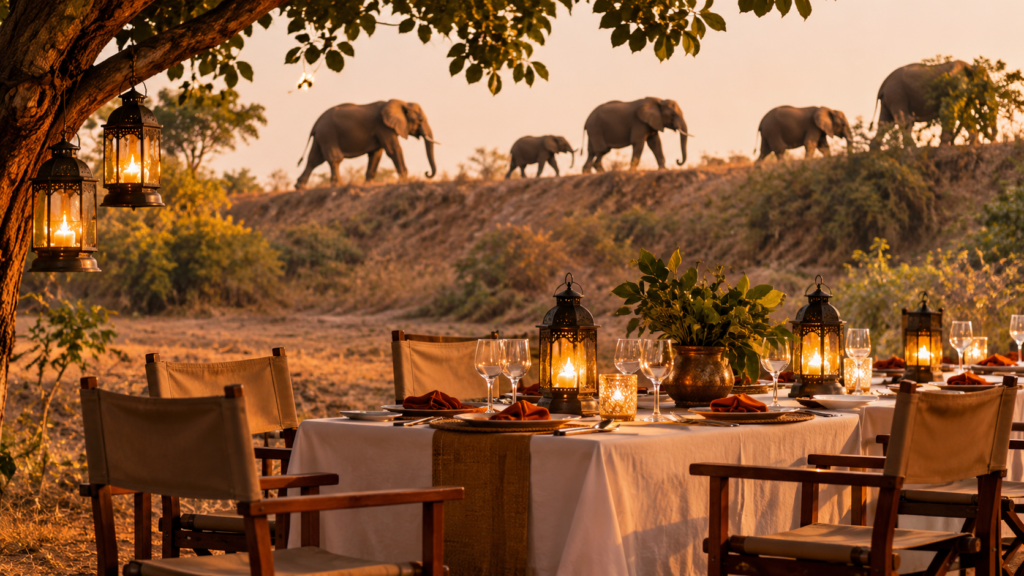
Imagine preparing a three-course dinner in the African wilderness.
The tables are set in a dry riverbed, lanterns are arranged for the evening, and a team of chefs, assistants, and waiters is getting ready to welcome guests. There is no conventional restaurant kitchen here, no familiar dining room, and certainly no guarantee that the evening’s only visitors will be human.
Across the ridge, elephants are walking.
For Chef Katendi Nkanza, affectionately known as Kate, this was one of the most memorable sights of her time working in Zambia’s Lower Zambezi National Park.
She had stopped by to check on preparations for a bush dinner when she looked across the riverbed and saw the animals moving along the ridge above.
It was, she recalled, one of the most beautiful things she had ever seen.
But how does a woman who once travelled to Malaysia intending to study computer science find herself preparing fine dining experiences in the African wilderness?
To understand that we must travel back to where Kate’s story began.
Where the Heart Is?
“Linear stories are so old fashioned,” Kate joked when asked where her story began.
For her, the answer was simple: Zambia.
Born Katendi Nkanza, Kate grew up in a family of five girls. Family has always been central to her life, and she describes her sisters as a close-knit tribe whose members would do anything for one another.
Food was another important part of her upbringing.
Her mother was an excellent cook, and in their household, learning to prepare meals was considered just as valuable as academic achievement. Children were expected to learn not only how to succeed in school but also how to look after themselves.
Kate watched her mother cook, experimented with herbs and spices, and gradually discovered that her interest in food went beyond enjoying a good meal.
She loved the process of creating one.
Yet cooking was not the original reason she left Zambia.
A Different Kind of Education
Kate’s decision to study abroad began, rather unexpectedly, with a tourism advertisement.
One day, while watching television at the office, she saw an advertisement promoting Malaysia. The beaches, palm trees, and unfamiliar landscapes caught her attention.
She wanted to go.
A week or two later, an exhibition featuring Malaysian educational institutions took place. To Kate, the coincidence felt like a sign.
She had considered Australia, the United States, and the United Kingdom, but Malaysia became her destination.
Her initial plan was to study computer science.
Instead, she found herself drawn to culinary arts.
The interest she had developed in her mother’s kitchen had never disappeared. Once she began formal culinary training, she discovered that her natural ability could become something much more.
She studied at KDU College in Kuala Lumpur, in conjunction with IMI University in Switzerland, earning a bachelor’s degree in international hospitality and European Culinary Management.
But the classroom was only one part of her education.
Kate had previously lived in Russia, and Malaysia became another important chapter in her experience of the wider world.
Living among people from different countries, cultures, and backgrounds challenged her assumptions and expanded her understanding of herself.
She formed friendships with people from across Africa and beyond. Some of those friendships became so important that the people she met abroad would later become godparents to her son.
The experience taught her adaptability, resilience, and the importance of remaining curious about the world.
It also reinforced something she had always believed: exposure matters.
She did not want her understanding of life, people, or professional possibilities to be limited by the place where she was born.
And yet, after years of discovering the world, Kate felt drawn back to Zambia.
Bringing the Experience Home
Returning to Zambia was not the end of Kate’s adventure.
It was the beginning of another.
She wanted to contribute to the development of the country’s culinary scene and share what she had learned through her experiences abroad.
In particular, she believed there was room to explore new approaches to food, develop culinary talent, and introduce different techniques while appreciating African ingredients and traditions.
Her vision was not simply to cook good food. She wanted her work to contribute to something larger.
In 2017, while still in Kuala Lumpur, she established Kate In Your Kitchen.
When she returned to Zambia in 2018, she decided to pursue the business seriously.
The beginning was anything but glamorous.
She had no start-up capital, no equipment, and little knowledge of the local market.
What she did have was her culinary training, her passion, her family’s support, and a willingness to begin before everything was in place.
Her first event resulted in a substantial financial loss.
Kate laughs about it now.
Despite losing money, she enjoyed the experience and learned valuable lessons. Her family showed up to help, and they continued supporting her at subsequent events.
Gradually, the business developed.
She offered private chef services, participated in food markets and events, and provided training to home cooks and restaurant chefs.
She also brought Braai in the City to Lusaka, building on an event concept she and her best friend had originally launched in Malaysia.
Her culinary interests were not limited to one cuisine or one way of cooking.
She wanted to explore connections between African food traditions and techniques from elsewhere in the world.
Her company’s slogan captured that curiosity:
“Exploring the World, One Dish at a Time.”
The Honey Badger Philosophy
Ask Kate about her early influences, and you might expect her to mention a celebrated chef, an entrepreneur, or a historical figure.
Instead, she names the honey badger.
Not the lion, traditionally celebrated as the king of the savannah, but the much smaller creature known for its remarkable tenacity.
To Kate, the honey badger represents qualities she admires: determination, boldness, and the refusal to be intimidated by difficult circumstances.
She has carried that spirit into her professional life.
Her decision to start a business without significant resources required courage. So did returning to Zambia and building a career in a market she was still learning to understand.
But perhaps one of her most unusual professional decisions was yet to come.
She would leave the familiarity of conventional kitchens behind and venture into the bush.
A Kitchen Without Walls
At the time of our 2024 conversation, Kate was Head Chef at Anabezi, a luxury tented safari camp in Zambia’s Lower Zambezi National Park.
Becoming a safari chef was a new experience for her.
She had never lived in the bush before, and the transition was not entirely comfortable.
In fact, she admitted that the first few weeks were filled with anxiety.
Fortunately, she had begun camping several years earlier, an experience she believed helped prepare her for life in the wilderness.
The work demanded a different kind of creativity.
Ingredients were not always readily available, and cooking outside the main camp required careful planning.
For a bush dinner, much of the preparation took place in the camp kitchen. Ingredients were marinated, dishes were prepared in advance, and desserts were made before the team transported everything to the outdoor dining location.
There, the team arranged tables, cooking equipment, a bar, and a service area.
Guests could enjoy drinks beside a bonfire before being served their meal.
Some dishes were finished on a barbecue stand, while others were plated and served after being prepared in camp.
All of this took place in an environment where wild animals roamed nearby.
For Kate, the experience combined several things she loved: food, adventure, people, and the opportunity to learn something new.
She also spoke with great appreciation for the people working alongside her.
Her fellow chefs and assistants played an essential role in making the elaborate outdoor dining experiences possible.
She understood that even the most talented chef could not deliver such experiences alone.
The wilderness may have tested her confidence, but it also expanded her understanding of what her profession could look like.
Cooking From the Heart
For Kate, food is deeply personal.
She describes cooking as a passion that has accompanied her since childhood.
Her approach is not simply about technique or presentation. She wants guests to feel the care that goes into every dish.
She believes good cooking requires a willingness to learn, to experiment, and to understand the people who will be eating the food.
Working in safari hospitality exposed her to guests from different countries and cultures. She considered those encounters opportunities to discover new ingredients, learn about unfamiliar cuisines, and expand her own culinary knowledge.
Her curiosity extended beyond the kitchen.
She spoke about the importance of cultural traditions, including how literature such as Chinua Achebe’s Things Fall Apart encouraged her to think about the relationship between food, identity, and heritage.
For her, culinary creativity did not mean abandoning African traditions.
It meant appreciating them while remaining open to new possibilities.
The Woman Beyond the Kitchen
Behind Kate’s professional ambition is a woman who speaks with enormous affection about her family.
She is a daughter, a sister, and a mother.
Her son, Nathanael, occupies a particularly important place in her life.
Kate has spoken openly about the profound sense of purpose she experienced after becoming a mother.
When professional demands leave her physically or mentally exhausted, she draws encouragement from her family, her faith, and especially her son.
A photograph, a voice message, or a conversation with him can help her regain perspective.
But balancing motherhood with a demanding culinary career has also required sacrifices.
During our interview, Kate admitted that she could barely remember the last time she had enjoyed uninterrupted time for herself.
Her days revolved around work, her child, and her family.
Asked what an ideal day of rest would look like, she imagined a slower morning with coffee, a good book, journaling, prayer, a bubble bath, and perhaps a visit to the spa.
Simple pleasures that a demanding schedule had made difficult to enjoy.
It was a reminder that behind the professional accomplishments and adventurous photographs was a woman navigating the ordinary, complicated demands of life.
More Than a Career
When Kate reflected on the influence of living abroad, she spoke about more than professional qualifications.
Her experiences had helped her become more adaptable, open-minded, and resilient.
They had also given her a network of relationships that crossed borders and cultures.
Those relationships enriched her life and influenced how she approached both people and opportunities.
Her time overseas had reinforced her belief that dreams require active participation.
Nothing meaningful would simply be handed to her.
She had to be willing to pursue the life she wanted.
That conviction helps explain why she chose to return home, start a business without substantial resources, and later embrace an unfamiliar professional environment in the wilderness.
It also explains her desire to share her knowledge with other chefs.
For Kate, the skills and experiences she acquired were not meant to remain hers alone.
They could become part of what she contributed to Zambia.
The Next Adventure
When asked what advice she would give aspiring safari chefs, Kate returned to the importance of passion.
She believed anyone entering the profession needed to be willing to learn, adapt, work creatively with limited resources, and genuinely appreciate the environment in which they would be living.
Above all, they needed to understand that the work was not always as effortless as the beautiful photographs might suggest.
It required preparation, flexibility, and commitment.
But for someone who loved adventure, the experience could be extraordinary.
In 2024, Kate was already looking forward to whatever came next.
Her journey had taken her from Zambia to Russia and Malaysia, back home to entrepreneurship, and eventually into the wilderness.
Each place had contributed something to the woman and chef she was becoming.
And perhaps that is what makes her story worth sharing.
Not simply that she became a chef, founded a business, or prepared meals in remarkable locations.
But that she remained willing to explore unfamiliar possibilities, learn from them, and bring something of that knowledge back to the place she called home.
Somewhere in the Lower Zambezi, elephants once crossed a ridge above a dinner she was preparing.
It is an unforgettable image.
And a fitting one for a woman whose journey has never followed an entirely predictable path.
— Salima, Our Stories On The Map
Enjoyed this story? Buy OSOM a coffee and help us find the next one. ☕